

Picture this. You and your friend are booking the same flight, at the same time, on the same website. You refresh the page together, just to compare. Your friend’s screen shows fifteen dollars less than yours.
Your screen
Standard fare
Economy · Seat booked now
Your friend’s screen
$15 less
Same flight · Same moment
Same seat. Same day. Same airline. Different price.
It sounds like a glitch. It’s usually not. It’s a pricing strategy that’s gotten a name over the last couple of years: surveillance pricing. And once you know what it is, you start seeing it everywhere, from hotel bookings to your weekly grocery order.
So what actually is surveillance pricing?
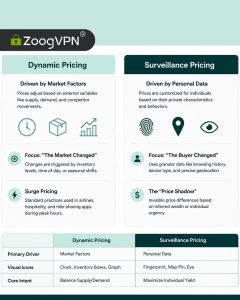
Surveillance pricing is when a company uses your personal data, things like your location, your browsing habits, the device you’re using, your past purchases, even the way you move your mouse around a page, to set a price that’s tailored just for you. Not for “people in your area” or “people shopping this week.” For you, specifically, based on what the company thinks you’re willing to pay.
And yes, even the device you shop from can matter. Someone browsing from an expensive smartphone, a work laptop, or a high-end tablet may be treated differently from someone using an older device. Companies can use this kind of information to guess your income level, habits, or urgency, and then adjust what you see accordingly.
That’s different from regular dynamic pricing, which most of us have made peace with. Surge pricing on a rideshare app during a rainstorm is dynamic pricing. It goes up for everyone because demand went up for everyone. Surveillance pricing skips that logic entirely. It’s not asking “what’s the market doing?” It’s asking “what can I get out of this one person?”
Think of it like a flea market vendor who sizes you up before quoting a price, except instead of glancing at your shoes, the vendor has read your diary, your search history, your bank statement, and knows exactly what device you’re shopping from.
What data is actually feeding this?
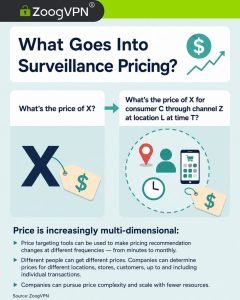
This is the part that tends to make people put their coffee down. Regulators looking into the practice found that companies can track details as small as which items you left sitting in your cart without buying, or how your cursor moves across a page, and fold that into pricing decisions. Add in your location, your browsing history, your device type, and your shopping patterns, and a company can build a surprisingly accurate picture of your price ceiling before you’ve even hit “checkout.”
Browsing history
Device type
Cart activity
Cursor movement
Account logins
Another red flag in apps: do not ever shear your location with an app unless it specifically needs it. For example, sharing your location ‘while using the app’ with food delivery is totally normal. While a language learning app, definitely doesn’t need to see where you are located.
None of this requires anything exotic. Most of it comes from the same cookies, trackers, and account logins you interact with every single day.
Real examples, because this stuff is easier to believe with receipts
Case study
The new-parent thermometer.
Regulators pointed to a scenario that’s become the go-to example of how this works: a retailer notices you’ve recently bought baby items, then notices you’ve been searching for fever symptoms, puts two and two together, and marks up a fast-delivery baby thermometer. Nothing about that is illegal on its face. It’s just uncomfortably specific.
Case study
The Mac users paid more.
Back in 2012, it came out that a major travel booking site was showing Mac users pricier hotel options than PC users, on the theory that Mac owners tend to spend more. It’s an old story, but it’s the one that got a lot of people paying attention to this in the first place.
Case study
The Instacart grocery experiment.
This one’s recent and it’s a good one. An investigation by Consumer Reports, Groundwork Collaborative, and More Perfect Union found that identical grocery items on Instacart could be priced up to 23 percent differently for different shoppers ordering from the same store at the same time. Their estimate: those differences could add up to roughly $1,200 a year for a typical family of four. Instacart pushed back hard on that number, calling it misleading and pointing out that these were short-term A/B price tests rather than personalized “surveillance” pricing tied to individual shoppers. Whichever side of that argument you land on, the practical outcome was clear: within days of the investigation going public, Instacart announced it was shutting the whole program down.
Is any of this actually legal?
Here’s where it gets interesting, because the answer right now is “it depends where you live, and it’s changing fast.”
Mid-2024 → January 2025 · Federal
The U.S. Federal Trade Commission opened a formal inquiry into surveillance pricing in mid-2024 and published its initial findings in January 2025, confirming that companies were indeed using granular personal data, down to mouse movements and abandoned carts, to shape prices. Worth noting: this was a fact-finding study, not a legal ruling. The FTC never concluded that surveillance pricing itself breaks the law, and under new leadership, the agency’s follow-up work on the study has largely stalled, which prompted a group of senators to publicly push the FTC to pick it back up.
Late 2025 · New York
New York’s Algorithmic Pricing Disclosure Act took effect in late 2025, requiring companies to clearly disclose when a price was set by an algorithm using your personal data (down to a specific required disclosure line near the price itself).
Early 2026 · California
California’s Attorney General opened an investigative sweep into retailers, grocers, and hotels in early 2026, looking at whether the practice violates the state’s privacy law, and a bill that would ban surveillance pricing outright is moving through the state legislature.
April 2026 → October 2026 · Maryland
Then in April 2026, Maryland became the first state to pass an outright ban, specifically for grocery stores and food delivery services, set to take effect this October.
So no, this isn’t settled law yet. But the direction in which it’s movingl is pretty obvious, and it’s not toward “keep doing this quietly.”
How much do people actually hate this?
A lot, as it turns out. A Consumer Reports survey found that 66 percent of Americans opposed retailers charging different people different prices for the same product based on their personal information. A follow-up survey found even higher opposition once people understood the specifics: 76 percent objected to loyalty programs offering discounts based on demographics like age or income, and 72 percent objected to discounts based on browsing behavior and device type.
66%
opposed different prices for the same product
76%
objected to loyalty discounts based on age or income
72%
objected to discounts based on browsing and device data
Translation: this isn’t a niche privacy concern for the tinfoil-hat crowd. Most people find it genuinely unfair once they understand how it works.
What you can actually do about it
You can’t opt out of the entire data economy before dinner tonight, but there are a few habits that meaningfully reduce how much of a target you make yourself.
Quick defense checklist
Shop in a private or incognito browser window, especially for big purchases like flights and hotels
Clear cookies regularly, or use a browser that blocks third-party trackers by default
Compare prices across different devices, not just different tabs
Be selective about which loyalty programs you hand your data to, and read what they actually collect
Reduce the location and IP signals that companies use to build your profile
That last one is where a VPN genuinely earns its place in this conversation.
Masking your IP address and location makes it harder for a company to build the location-based part of your pricing profile, and it breaks some of the cross-session tracking that ties your browsing together over time.
It’s not a silver bullet though, and it’s worth being honest about that: a VPN won’t stop pricing tied to your logged-in account, your loyalty number, or your device fingerprint.
Think of it as removing one input from the equation, not switching the equation off entirely.
Take back a little control over your data
Surveillance pricing runs on the signals you leave behind, especially your location and IP address. ZoogVPN masks both, so you’re browsing and comparing prices with one less trail for algorithms to follow.
- Roksolana KogutRoksolana dives deep into online privacy, security, and the tools that make the internet work better for everyone. She has a natural taste for taking technical subjects and making them feel approachable, useful, and worth reading.


