


Roughly one in three internet users worldwide is estimated to use a VPN, and in the U.S. the share of adults using one jumped to 42% in 2026, according to Security.org – proof that VPNs have gone far beyond just the domain of privacy-obsessed techies or region-hopping streamers. Today, VPNs serve a much broader purpose: they help secure sensitive data on public Wi-Fi, fight government censorship, protect against ISP tracking, and even stop websites from fingerprinting your device or location.
What has provoked the surge? The biggest driver is growing concern over personal data privacy; users are wary of how much information companies, advertisers, and even governments collect about them online. Alongside this, the rise in data breaches, aggressive advertising trackers, global surveillance, and regional content restrictions have fueled today’s active adoption of VPNs.
In this article, we’re diving into the latest numbers on VPN usage, trends shaping the industry, where VPNs are most popular, and why tools like ZoogVPN are becoming an everyday essential.
VPN Popularity Over Time
Apparently, VPNs didn’t come into wide use overnight. Google Trends shows steady VPN adoption rate growth since 2010, with big spikes, tightly connected with the global events. Each of these moments triggered a behavior shift. As a result, every time digital freedom takes a hit, VPN usage surges.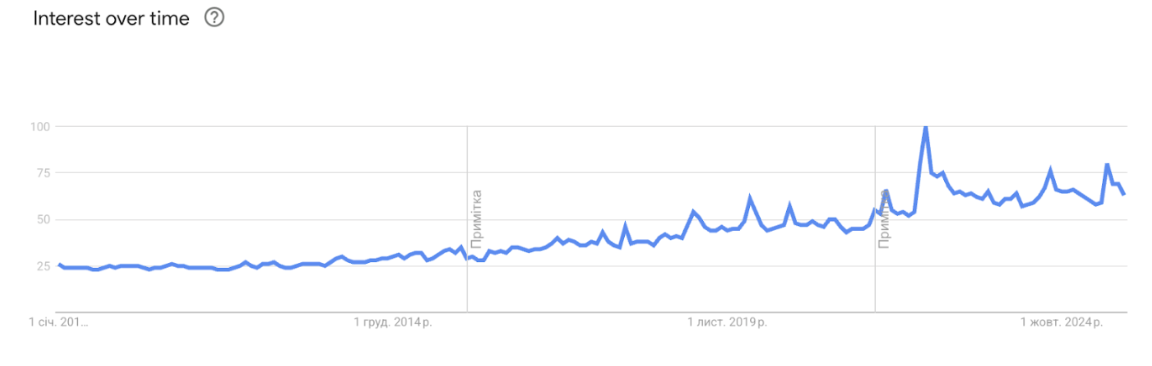
2020
The COVID-19 pandemic pushed remote work into the mainstream. Suddenly, millions of people were handling sensitive work data over home routers and public Wi-Fi in coffee shops. VPNs became integral for connecting to company servers from outside corporate firewalls.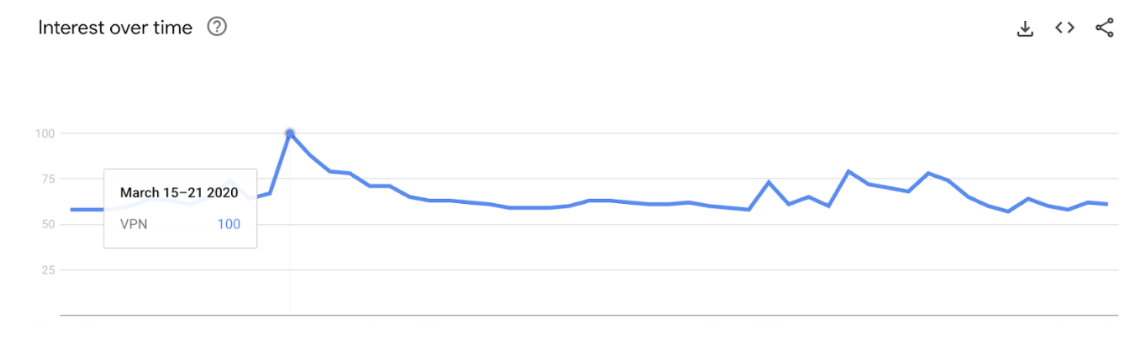
2022
Political unrest and crackdowns in countries like Russia and Iran drove people to find ways around censorship. Here, VPNs were heavily employed for accessing news, social media, and communication tools that were otherwise blocked.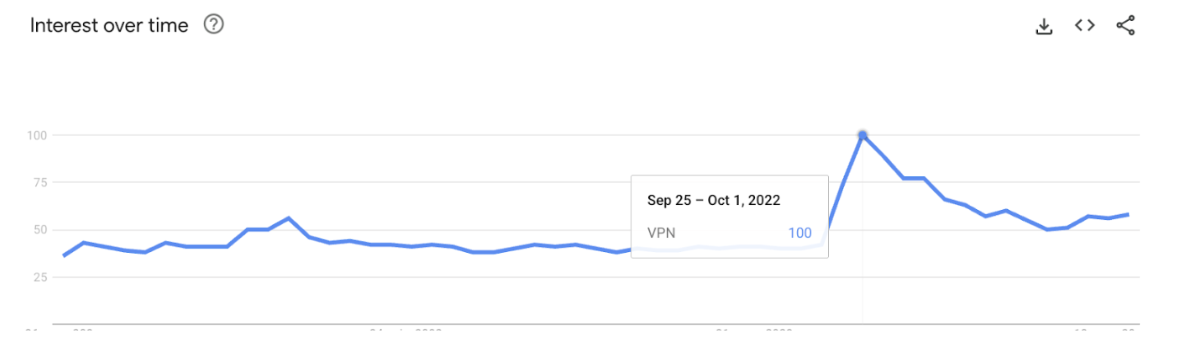
2024–2025
A global rise in cyberattacks, ransomware campaigns, and regional content blocks (especially across streaming and gaming platforms) is pushing more users toward VPNs. For some, it’s about securing their credentials; for others, it’s about coping with new digital borders.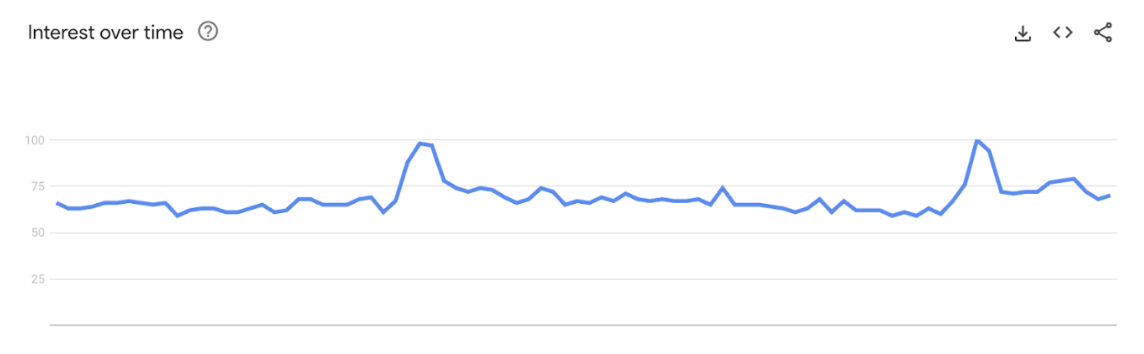
The Global VPN Market Today
The VPN industry is a truly booming global market today. The steady rise of cybercrime, online surveillance, and digital restrictions has created strong demand for these tools. Looking at the worldwide market size and adoption rates gives us a sense of how VPNs are evolving into a mainstream technology rather than just a niche security product.
- The global VPN software market is estimated at USD 3.33 billion in 2026 and is projected to reach USD 12.74 billion by 2035 at a 16.2% CAGR. (Business Research Insights)
- Estimates for the wider VPN market, which include consumer and enterprise VPN services, are much larger: IMARC Group valued it at USD 54.1 billion in 2025 and expects USD 155.9 billion by 2034 (12.11% CAGR). (IMARC Group via Research and Markets)
- By 2025, 1.75 billion people worldwide – about one-third of all internet users – are estimated to use VPNs. (Forbes)
VPN Server Software Market
The VPN server software market is experiencing rapid growth, with the global demand for secure and private internet connections. Estimated at about USD 2.83 billion in 2026, it is projected to grow to around USD 9.5 billion by 2035, representing a CAGR of about 16.2%. (Business Research Insights)
Regional Growth
North America currently holds the largest revenue share, while the Asia Pacific region is the fastest-growing market, supported by expanding internet access, rising cybersecurity awareness, and increased enterprise adoption.
User Base
Corporate users dominate the market, reflecting their critical need for secure enterprise networks. Meanwhile, personal VPN users are the fastest-growing segment due to increasing privacy concerns. 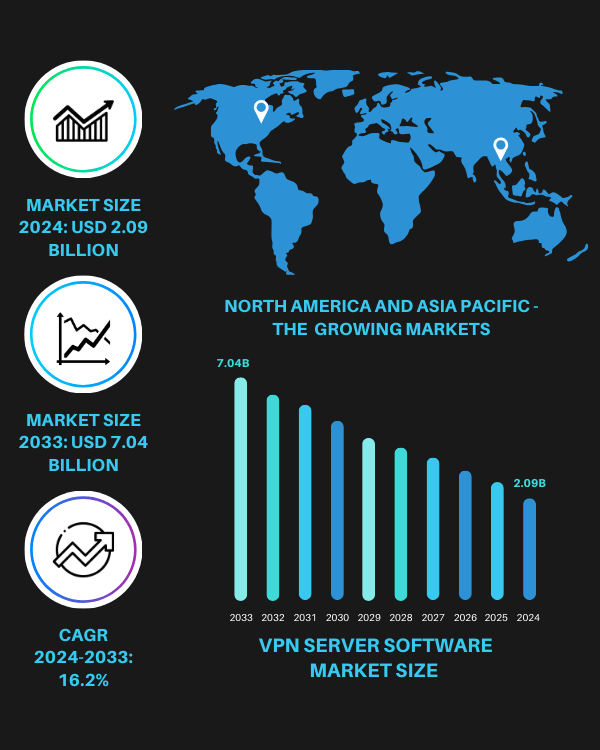
VPN Usage in the United States
According to Security,org, between 2021 and 2023, VPN adoption in the U.S. hovered around 10% for combined personal and business use, while personal-only usage peaked at 23% in 2023. In 2025, usage dipped: only 7% of adults used VPNs across both personal and business devices, and 68% reported not using or being unaware of VPNs at all. The 2026 survey (1,008 U.S. adults, August 2026) shows a sharp rebound: 42% of adults now use a VPN, up from 32% in 2025, and personal-only use rose to 25%. Security.org did not publish separate 2026 figures for business-only or mixed use, so those cells are left blank below.
| Year | Personal & business | Personal only | Business only | Don’t use / unaware |
| 2021 | 10% | 18% | 14% | 58% |
| 2022 | 9% | 17% | 13% | 61% |
| 2023 | 10% | 23% | 13% | 54% |
| 2025 | 7% | 17% | 8% | 68% |
| 2026 | – | 25% | – | 58% |
Motivations for VPN Use in the U.S.
To understand VPN adoption rate, it helps to know what people actually use them for. Privacy, security, and content access remain top drivers, but workplace use and ISP avoidance are on the decline. Here are the core reasons why people use VPNs in America (multiple responses allowed):
| Motivation | 2021 | 2022 | 2023 | 2025 |
| General privacy | 54% | 50% | 63% | 60% |
| General security | 55% | 55% | 54% | 57% |
| Secure public Wi-Fi | 34% | 24% | 36% | 37% |
| Prevent tracking (Google/Facebook) | 18% | 17% | 39% | 32% |
| Job requirement | 38% | 34% | 39% | 25% |
| Online shopping security | 24% | 20% | 25% | 25% |
| Access geo-restricted media | 19% | 22% | 28% | 23% |
| Hide activity from ISP | 23% | 23% | 35% | 21% |
| Torrenting | 13% | 12% | 21% | 13% |
| Activism/journalism | 3% | 5% | 4% | 6% |
The 2026 edition of the survey reports only the leading reasons: general privacy (56%), general security (51%), access to international or non-local media (27%), reducing online tracking (27%) and hiding activity from the ISP (25%). More than one in ten users also use a VPN for age-restricted content.
U.S. User Demographics
Not everyone uses VPNs equally. Age, gender, and technical knowledge all play a role in shaping who adopts VPNs in the U.S., and why.
- Age: In 2026, 51% of Americans aged 18–29 use a VPN, the highest of any age group, while nearly two-thirds of adults 60 and older do not use one.
- Gender: 50% of men use VPNs vs. 40% of women (2026).
Knowledge gap: Those highly familiar with VPNs are more likely to use advanced tools like Tor alongside them.
Paid vs. Free VPNs in the U.S.
While free VPNs may sound like a sweet deal, many come with hidden costs: weak or no encryption, annoying ads, data logging, and worse – selling your data to third parties. Even so, free VPNs remain popular in the U.S., and their share has swung back and forth.
- In 2023, 43% of users relied on free VPNs; by 2025 this fell to 28%, and in 2026 it climbed back to 43%.
- Paid users reported spending an average of $21/month in 2026.
You can discover the comprehensive comparison of free vs. paid VPN services in our guide. For those seeking solid free-or-charge options, ZoogVPN’s free plan provides basic privacy features without the usual compromises of free services. Besides, to obtain the full list of features we offer, and ensure top-tier privacy, you can upgrade to a paid tier anytime.
VPN Usage in the United Kingdom
As Forbes claims, the UK is another key market for VPN adoption, with almost half of Brits using VPNs in some form. In fact, the VPN market overall is projected to hit USD 76 billion by 2027, due to the growing concerns about privacy, surveillance, and online security. Awareness is high, but usage varies widely depending on age, gender, and digital habits.
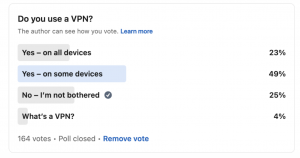
- As of June 2025, 49% of Brits use a VPN on at least some devices.
- 23% use VPNs across all their devices.
- 25% don’t feel the need for one, while 4% don’t know what a VPN is.
- Awareness is high: 76% of Brits have at least some familiarity with VPNs.
The biggest change since that survey came from the Online Safety Act. Once mandatory age checks for adult sites began on 25 July 2025, daily VPN use in the UK more than doubled: Ofcom’s Online Nation 2025 report counts about 650,000 daily users before that date, a peak of over 1.4 million in mid-August 2025 and around 900,000 in November 2025.
Age and Gender Differences
Just like in the U.S., younger and male users in the UK are more likely to understand and adopt VPNs. Awareness drops sharply among older generations.
| Group | Awareness / Recognition | Strong Understanding |
| 18–24 years | 70% understand well, 17% basic recognition | 70% |
| 25–34 years | 78% awareness (total), 41% clear understanding | 41% |
| 65+ years | 57% awareness (know what VPNs are) | Lowest |
| Men | 43% | |
| Women | 21% |
Devices and Platforms Brits Use for VPNs
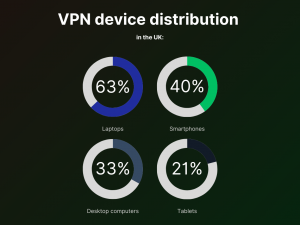
VPN usage in the UK is device-driven, with laptops leading the way. Smartphones are increasingly popular, but desktops and tablets lag behind.
- 63% laptops
- 40% smartphones
- 33% desktop computers
- 21% tablets
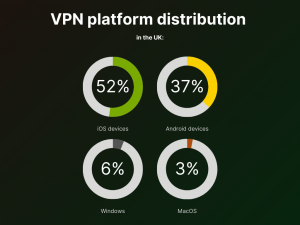
Device distribution shows that VPNs are primarily used on:
- 52% iOS devices
- 37% Android devices
- 6% Windows
- 3% MacOS
Frequency of VPN Use
Not all VPN users rely on the service equally. Frequency varies significantly depending on the device, with laptops seeing heavier use than mobile devices.
- On laptops/desktops:
- 21% use more than once daily
- 31% daily
- 22% several times a week
- On mobile devices:
- 25% more than once daily
- 15% daily
- 24% several times a week
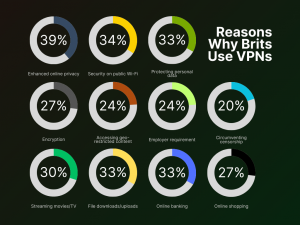
Why Brits Use VPNs
British users rely on VPNs for both personal privacy and practical tasks like streaming, shopping, and online banking. Workplace and censorship-related use cases are also notable.
- Enhanced online privacy: 39%
- Security on public Wi-Fi: 34%
- Protecting personal data: 33%
- Encryption: 27%
- Accessing geo-restricted content: 24%
- Employer requirement: 24%
- Circumventing censorship: 20%
- Streaming movies/TV: 30%
- File downloads/uploads: 33%
- Online banking: 33%
- Online shopping: 27%
Paid vs. Free VPNs in the UK
While free VPNs remain common in the UK, dissatisfaction with performance is pushing more people toward premium services with better reliability and features.
- 52% of Brits have tried free VPNs.
- Among them, 60% still use free VPNs, while 34% switched to paid due to performance/security issues.
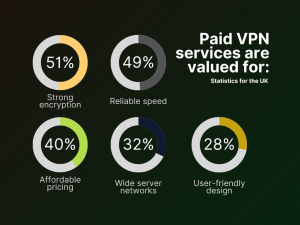
Paid services are valued for:
- Strong encryption (51%)
- Reliable speed (49%)
- Affordable pricing (40%)
- Wide server networks (32%)
- User-friendly design (28%)
Are VPNs Legal Worldwide?
In most countries – yes, VPNs are completely legal. But in about 15–20 countries, they’re restricted or heavily monitored. These cover:
| Country | Status |
| China | Restricted, approved VPNs only |
| Iran | Limited to government-approved tools |
| Russia | Legal but must comply with censorship; advertising is prohibited |
| UAE | Legal but misuse penalized |
| North Korea | Banned |
| Turkmenistan | Banned |
Thankfully, stealth features like ZoogVPN’s Shadow protocol help users safely overcome these limitations without detection.
Cybercrime Trends in the U.S.
It’s vital to mention that the digital world isn’t getting any safer. According to the FBI’s Internet Crime Complaint Center (IC3), in 2025 the U.S. recorded 1,008,597 complaints of internet-enabled crime, the first year above one million – almost 3,000 reports a day. Reported losses hit a record $20.877 billion, up 26% from 2024. Phishing kits, info-stealing malware, credential stuffing – these threats are part of everyday life online. While a VPN won’t stop all of them (nothing will), it does one job extremely well: it encrypts your data and routes it through secure servers, making it much harder for third parties, or attackers on the same network, to intercept your traffic.
VPN Usage Outlook for 2027 and Beyond
Today, VPNs are a basic part of modern digital hygiene which is adopted for everything from binge-watching abroad to shielding your identity from cyber creeps. Whether you’re working remotely, traveling, gaming, or just want peace of mind, the right VPN can satisfy all these needs. And with providers like ZoogVPN offering powerful features at wallet-friendly prices, there’s really no excuse not to protect your digital life. Start using ZoogVPN now and see what a quality VPN service really feels like.
Get ZoogVPN
Save 75% off today
$2.49
/mo $9.99
- Up to 10 devices
- 140+ servers and 80+ countries
- Independently audited no-logs
- 24/7 live support