


You’ve probably done this yourself. Copied a paragraph from a client email, a chunk of code, maybe a whole document, and pasted it into a chatbot because it was faster than doing the thing manually. Most people have. That’s not a confession, it’s just what shadow AI looks like in practice: not some dramatic breach, just an ordinary Tuesday where a genuinely useful shortcut quietly sends company data somewhere nobody signed off on.
What Is Shadow AI, Exactly?
Shadow AI is what security people call it when employees use AI tools, chatbots, writing assistants, meeting transcribers, image generators, without their company’s IT or security team knowing about it, let alone approving it. Think of it as the AI-era version of shadow IT, which used to mean someone signing up for their own file-sharing app because the official one felt clunky. Same instinct, much bigger stakes, because this time the tool isn’t just storing files. It’s reading them, processing them, and in some cases learning from them.
There’s a real line between sanctioned and unsanctioned AI here. Sanctioned AI is the tool a company picked, tested, and put a contract around, the kind where someone in legal has actually read the data processing terms. Shadow AI is whatever a person downloaded or signed up for on their own, usually through a free personal account, because waiting for approval felt like it would take forever.
Why It Took Off So Fast
It’s not exactly a mystery why this spread so quickly. These tools are free or close to it. There’s nothing to install, no ticket to file with IT, no months-long security review to sit through. And here’s the part that makes it hard to police: the tools genuinely work. A chatbot really can turn a messy pile of notes into a clean summary in under a minute, and when someone’s underwater with deadlines, that’s not a small convenience.
Meanwhile, IT teams are chasing a moving target. New AI tools show up almost every week, and most existing policies were written with spreadsheets and cloud storage in mind, not something that can read a document and quietly retain what it learned from it. Microsoft and LinkedIn’s Work Trend Index found that 78 percent of professionals who use AI at work are bringing their own tools instead of company-approved ones, and Varonis’s 2025 State of Data Security Report found that 98 percent of organizations have employees using unsanctioned AI or apps. This isn’t a handful of rule-breakers. It’s most of the workforce, doing what feels like the obvious thing.
The Real Risks (This Is the Important Part)
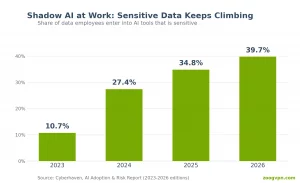
- Data leakage. Once something’s pasted into a public AI tool, control over where it goes is gone. Some platforms train future models on it unless you opt out, some log it indefinitely. 43 percent of office workers have already entered work correspondence into public AI tools, and a third have gone as far as customer data.
- Compliance exposure. GDPR, HIPAA, and most industry regulations don’t have a “but I only pasted it into a chatbot” exception. Patient records, financial details, or EU customer data landing in an uncovered tool is a compliance problem regardless of intent.
- Credential and API key leakage. Pasting code into a chatbot for debugging help often means pasting the live API key or database password sitting right in it. That key doesn’t vanish once the chat window closes. If you have ever done this before, you might notice that newer AI usually warn you about this, of course it is not universal and does not change the fact, not to do this in the first place.
- Hallucinated output treated as fact. Chatbots sound confident whether they’re right or not. Wrong output used in a legal clause, a financial projection, or a compliance answer becomes a real mistake, quietly, with nothing flagging it.
- Unvetted browser extensions. Plenty of “AI-powered” add-ons request sweeping permissions and read every page you visit, internal dashboards included, with almost no vetting of who built them or where the data goes.
It’s Already Happened, More Than Once
Samsung is the example everyone remembers.
In 2023, its engineers reportedly pasted sensitive company data into ChatGPT three times in just a few weeks. They used it to debug source code, improve a defect-detection algorithm, and turn a confidential meeting recording into notes.
No one was trying to cause a leak. They were just trying to work faster.
But once the data was entered, Samsung had a problem. The company responded by banning generative AI tools across the business.
The story did not end there. In 2026, Samsung began rolling out an enterprise version of ChatGPT to more than 100,000 employees, with data controls and admin oversight.
That is the real lesson: banning AI does not stop people from using it. It only pushes them toward unsafe tools.
The better answer is to give employees a safe, approved way to use AI before they find their own.
How to Actually Reduce the Risk
If you’re the one doing the pasting, the quickest gut check is this: would you be comfortable posting it publicly on social media? If not, it doesn’t belong in a chat box either.
Before you paste anything into a public AI tool:
- Never include client names, financial figures, health details, or anything that identifies a real person. Our guide on taking care of your digital privacy covers why this matters beyond just AI tools.
- Check the platform’s settings for data retention and model training. Most major chatbots let you opt out, the same way you’d manage third-party cookies that track you elsewhere.
- Treat every AI chat window like a message to a stranger. Assume nothing in it stays private, the same baseline rule we cover in how to use the internet safely.
- Strip out API keys, passwords, and credentials before pasting any code, even for a “quick” debug. If you’re not sure your credentials are already clean, here’s how to spot signs your accounts have been compromised.
If you’re the one setting the rules, an outright ban almost never works. It just pushes the same behavior further out of sight, onto personal phones and browser extensions nobody can see. What tends to actually help:
- A written AI use policy that spells out what’s off-limits, not a vague “don’t use AI” memo nobody reads.
- An approved tool people can actually use, so nobody’s forced to go around IT to get their job done. The same logic applies to network access, see our business VPN solution for secure remote access teams can actually use.
- Training that explains why the rules exist. Most people aren’t ignoring policy on purpose, they’ve just never been told where the line sits.
- Monitoring or DLP tooling that flags sensitive data before it leaves the network, rather than finding out after the fact.
Shadow AI isn’t a trend that’s fading out, and treating it like a fireable offense usually just teaches people to hide it better. The realistic goal is visibility: know what’s actually being used, set rules that match how people really work, and make the safe option the easy one.
Part of Your Digital Privacy Hygiene
A VPN can’t stop someone from pasting sensitive data into a chatbot, that’s a data-handling problem, not a network one, and no privacy tool fixes that on its own. What a VPN does cover is the layer right next to it: encrypting your connection, hiding your IP address, and keeping your browsing private on public Wi-Fi or networks you don’t fully trust. ZoogVPN handles that part, so the rest of your privacy habits have something solid to stand on.
- Roksolana KogutRoksolana dives deep into online privacy, security, and the tools that make the internet work better for everyone. She has a natural taste for taking technical subjects and making them feel approachable, useful, and worth reading.


